Wednesday, April 9, 2014

Teacher Education In and Through Technology

As an instructional technology instructor for preservice teachers at UNL, I've been invited to participate in a panel discussion at NETA on April 24th, 2014.

The panel is titled: Teacher Education In and Through Technology.

In this session, panelists and the audience will weigh in on the direction teacher education should take in and through technology. Teacher educators, teachers, preservice teachers and school administrators will be included responding to three questions:

  1. What skills and capacities do new teachers need to teach in the 21st century?
  2. How can teacher education programs foster such skills?
  3. How can schools as practica sites help preservice teachers develop?


Here are my initial thoughts, in the form of big ideas/themes, along with links to resources that may be helpful.
  • Autonomy! In my classes, rather than teach step-by-step how to use a given technology, I focus on pedagogical themes and have students explore various tools. I show them how to find and use technology tutorials and help guides online. This enables them to be prepared to deal with new technologies as they continue to emerge. Students, especially those who want to be teachers, must learn skills that promote autonomous learning beyond the classroom. There is a big emphasis in my class on professional development opportunities and sharing knowledge. I end my classes with a mini-practice conference and usually offer some extra credit opportunities for attending conferences and submitting reflections of their experiences. 
  • Practicality! I focus on teaching students how to apply any given technology for some purpose to avoid using technology just to be using it and think more critically about how it can enhance teaching and learning. I encourage them to think of materials they might one day use when developing assignments for my course. I tell them to save everything they create and try to find ways to use those materials in the future. 
  • Patience and learning from mistakes! Unfortunately, technology doesn’t always work the way we want or on the first try. I encourage my students to learn from their mistakes, always have a backup plan and several ways to accomplish the same task. I point out valuable ways tech can promote learning and coach them to have patience when learning and creating new materials.
  • Creativity! I begin my classes by pointing out to students that the statement, “I’m not good at technology” is a choice they are making and not inherent talent they lack. With patience and creativity, technology is useful and fun for both themselves and their future students. 
My courses include, but are not limited to, the following themes:
  • Critical Evaluation - I always begin my course by guiding students on how to effectively search the Internet and how to be critical consumers of what they find. There's more to Google than just randomly typing in terms and it is important for preservice teachers to know how to evaluate what they find and how to guide their students to do the same. Kathy Schrock has a great site of resources for evaluation of information.
  • Creating, Sharing, and Curating Resources - There's so many wonderful resources online. Once my preservice teachers have some practice combing through and evaluating what they find online, they need somewhere to keep up with it all. There are so many different ways to do this, but since I work with elementary education majors, I encourage them to use the very popular, Pinterest. They can create boards, share pins with colleagues, and develop their own collection of resources for their future classes. As an added bonus, my students say it is both addictive and fun. If you're unfamiliar or wish to know more about Pinterest, here's one guide I give my students to help them see the potential of this tool. Not convinced? Hear why you should fall in love with Pinterest from one of my students:
  • Digital Citizenship - Helping preservice teachers understand how to be safe and responsible online by highlighting the importance of keeping their future students safe really helps engage my students with the topic. Here's one article that I use most often
  • Whose? - One nice thing about the Internet is how it promotes a participatory, shared culture. Unfortunately, understanding ownership in regards to digital media can be tricky. I developed this website to help me briefly illustrate to my students just how complicated the issues of copyright and fair use can be. I also use it to introduce the concept of creative commons. 
  • Assessment - While I do stress the importance of various types of assessment and how technology can be used to promote more accurate and beneficial assessment, one example I show to my students is Flubaroo. Flubaroo is a script that runs within a Google spreadsheet to turn a standard survey-style form into a self-grading quiz. 
There are so many great ways to incorporate technology into education but it is most vital to remember that content-focused pedagogy must drive how technology is used in order for it to be most effective for learning. 

Sunday, September 9, 2012

Potential: Multicultural Education & Instructional Technology


Recovery of Meaning (a summary of Diaz) 
Multicultural education’s primary aim is equitable educational opportunity for all.  Basic assumptions must be challenged and reform of current policies and practices must occur. Multicultural education must also educate all students to become successful members of society. A basic assumption of the author is that a democratic nation cannot survive without a populace capable of striving in pluralism (Diaz, 2001, p. 13). Multicultural education benefits everyone. Interventions focused on improving the performance of minority populations are also good practices for all students. Critique is changing the twentieth century’s Anglo-centric curriculum.
Challenging multicultural education is the fear of a monolithic insurgency against Anglo American culture. Ironically, those who have always held the power most fear subjugation. Language is subverted to maintain the dominance of those in power. Their interests are the common good while marginalized groups are special interests. This terminology allows the dominant discourse to further marginalize their experiences. Curriculum must be reformed to allow space for the voices that challenge this status quo.
A transformative approach to curriculum change allows for multiple perspectives and fundamental reorganization of normative assumptions. As opposed to the contribution or the additive approach, which employ broad representative examples, the transformative approach allows for genuine exploration of multiple ways of knowing. The decision-making and social-action approach allows space for students to extend understanding.

Reconstruction of Meaning (a reading of Diaz) 
In certain disciplines where rhetoric is more highly conducive to practice, such as literature, philosophy, or anthropology, multicultural education is enacted in classroom practice with easily identifiable effects. However, in other disciplines, those that might be considered more pragmatic in nature such as instructional technology, it is sometimes less evident how to actively honor multiple ways of knowing. I do not intend to imply that the potential is limited, only that the ties are perhaps not as overt.
Banks emphasizes that multicultural education should do two primary things: (1) promote equity and (2) develop awareness of plurality in order to promote successful democratic citizenship. I would contend if the goal is Nussbaumian ideals of democratic participation, instructional technology is a primary discipline for reaching that goal. The potential of technology is rich, pluralistic understandings and more equitable access.

Reading at the Edges (connections) 
            In her presidential address to AERA, Gloria Ladson-Billings (2006) developed the metaphor of educational debt instead of the achievement gap. Her metaphor allows for the articulation of responsibility and methods for repaying it. In instructional technology another gap exists, the digital divide. It describes the inequity of access to technology for all students. Instructional technology has a great power for supporting multicultural education but it faces the challenge of a “technology debt,” if I may transfer Ladson-Billings’ metaphor. The infrastructure in the United States is improving. The latest FCC report on broadband data (August 2012) stated that access to the most current broadband has risen from 20% to 82% since 2009 in American households. Unfortunately, access is often limited by financial concerns. As long as broadband and electronics remain prohibitively expensive for many marginalized American families, the same inequities plague our system. Ladson-Billings spoke to the responsibility of the community to support education. It is also our responsibility to support access to the tools that can power that education. While progress is being made through grants and other means, much will always need to be done to struggle toward bridging the digital divide.

References
Diaz, Carlos F. (2001). Multicultural Education in the 21st Century. New York: Addison-Wesley Educational Publishers Inc. (Chapter 2- Multicultural Education: Goals, Possibilities, and Challenges, p. 11-22).
Ladson-Billings, G. J. (2006, April 9). From the achievement gap to the education debt: Understanding achievement in U. S. schools. In AERA Awards Presentation and Presidential Address. Retrieved September 8, 2012, from http://www.cmcgc.com/Media/WMP/260407/49_010_files/fdeflt.htm#nopreload=-1
Rapaport, R. (2009, October 27). The new literacy: Scenes from the digital divide 2.0. Edutopia. Retrieved September 8, 2012, from http://www.edutopia.org/digital-generation-divide-literacy
United States, Federal Communications Commission, Chief, International Bureau. (2012, August 13). International broadband data report. Washington, D.C.: Federal Communication Commision. Retrieved September 8, 2012, from http://transition.fcc.gov/Daily_Releases/Daily_Business/2012/db0821/DA-12-1334A1.pdf

Saturday, June 16, 2012

Collecting & Sharing Stock Photos

It is important when developing instructional materials to avoid potential copyright issues. One great way to do this is to take your own stock photos to save for future use. Think about things you might like to be able to post pictures of on a course website or use in a presentation. Science teachers might want a picture of a beaker or a lab or a tree, history teachers might want pictures from a museum, English teachers might want pictures to inspire poetry or writing projects, math teachers might want pictures that could be used to show how equations appear in real life like a half-built bridge or building, etc. You may want pictures of campus or the capitol or a pencil or backpack. Foreign language teachers may want to take some vocabulary pictures.
I used picasaweb to store and organize my pictures so that I can also share them with others and post them as part of my professional teaching portfolio. Here's how I did it: (be sure to click on the photos if all you can see are little gray icons)
  1. Start by logging into Picasa and clicking upload.
  2. Name your album
  3. Highlight and drag your images here 
  4. Click Ok at the bottom once it's done uploading 
  5. click on one of your picture and select add location 
  6. a map pops up where you can search for a place 
  7. zoom in and move the pin to exactly where you want to identify and click save location 
  8. click on the + tag symbol to the right of tags 
  9. type in some words that describe the picture to make it searchable (if you need to use a phrase or multiple words, use "quotes" around them) 
  10. Click on the title of the album at the top of the screen to go back to a full overview and choose "Actions" and them "album properties" 
  11. here you can change the title and description and other info but most importantly! check the privacy settings! You may choose "public on the web"; "Limited, anyone with the link"; or "Only you" depending on who you want to be able to see the album. If you wish to share it, choose one of the first two named options 
  12. save changes takes you back to the overview, now chose "captions" 
  13. this gives you an overview where you can tab through and create a caption for each photo 
  14. going back to the overview screen notice the options on the right 
  15. click on "link to this album" to get the link to share with others 

Wednesday, May 9, 2012

SIOT 2012 - Opening Day


For the next five weeks, I will be participating in the Summer Institute for Online Teaching (SIOT). SIOT is a Sloan-C award for Excellence recipient. Today we met for the first synchronous face-to-face meeting of the hybrid institute. Dr. Mandernach's presentation was titled "Teaching Online: Where do you begin?" She discussed things to avoid in an online class. The following is my (hopefully "accurate") notes on her top 10 list of Don't's:

10. Don't use the same teaching strategies you use in a face-to-face course! Explore the unique opportunities available online.
  9. Don't overload the course with too many resources. Point students to the most important information.
  8. Don't integrate all the tech "bells & whistles." Have a purpose for what you use.
  7. Don't monitor without participating. Be present in the course & discussions.
  6. Don't communicate primarily by email. Set up general question forums to avoid answering the same questions over and over again.
  5. Don't give too much freedom on due dates. Students need a schedule and deadlines.
  4. Don't save grading to the end of term. Students need feedback to be regular and formative. Set yourself due dates and let students know what they are so they will hold you accountable.
  3. Don't require a lot of synchronous activities. Most students take online classes because of schedule conflict. Whatever can be done with asynchronous tools, should be done that way. 
  2. Don't assume students know how to learn online. They need you to teach them to navigate the course and tools.
  1. Don't develop your course while you teach it. Plan ahead or you will be overwhelmed. 

Dr. Mandernach's full PowerPoint presentation will become available later and I will share that here. 

Dr. Williamson's presentation was titled "Getting Started in Our Quest to Instruct On Line: The Pep Talk." Dr. Williamson encouraged faculty to start by finding and utilizing the technology person that can help them through this process. She continued by encouraging instructors developing courses to try and view it from the student perspective and fix the confusing elements first. She emphasized the need to organize and label elements in order to guide students through the course. A few elements of teaching online that surprised Dr. Mandernach were the diversity of experience of her participants; the fact that groups often self-corrected; that three was simply too few for a group to have a meaningful and rich discussion, but that group collaboration works well. A final surprise she highlighted was that once the course was launched, the workload was not too overwhelming. 

I am excited to connect with the diverse group that the Office of Online and Distant Education has assembled. Hopefully we will all learn a lot as we work together. 

Sunday, April 22, 2012

Twitter for Educators

There are so many resources out there on using Twitter for educational purposes, it is sometimes difficult to make heads or tails of it. Here's a little mini lesson for my friends and colleagues interested in learning more about how to use this tool. I want to give you a few tips about hashtags and then share a list of my favorite educational tweeters and why I like them. I hope this is helpful.

Hashtags are those words you see with the # sign in front. They are the way information is organized and retrieved on Twitter.

  • One of the most popular hashtags is #FF and you'll see it often on Fridays. It stands for "follow Friday" and is a way in which people on Twitter recommend their favorite tweeters to their own followers. 
  • Within the scope of education, a very popular hashtag is #edchat and clicking on it or searching for it will give you a list of tweets related to education. Many education experts are discussing topics of interest in education at this very moment and you can get in on the conversation by replying to them and adding #edchat to your tweet as well.
  • At educational conferences a unique hashtag is often created to help participants use Twitter to communicate and network during the conference. Ask about a hashtag at your next professional development conference. 
A few of my favorite tweeters:
  • @TLTGROUP is the account for the Teaching, Learning, and Technology group, a non-profit organization that holds frequent online, free webinars on a variety of topics related to education. 
  • @EnglishRaven is an English teacher who blogs and often posts great instructional technology resources.
  • @EdTechSteve is a tech geek with a background in math and a desire to help teachers and students improving learning.
  • @BHobgood is a speaker whom I have had the pleasure to hear a few times. He is another technology person with a strong interest in culture and blended/online learning.
  • @ShawnTX is a technology expert at as school district in Texas and the co-host of a great podcast called the Tightwad Tech where they interview teachers and specialists to find great ways to exploit free/cheap instructional technology. I have spoken to Shawn a few times and was interviewed about social media once on the podcast. They are great guys with good senses of humor and fun to follow
  • @KathySchrock is a wonderful educator who publishes tons of resources online for free including her famous Bloomin' Apps! infographics. 
  • @ShellTerrell and @TomWhitby are co-founders of #edchat. Both post great links and lead the frequent #edchat discussions I mentioned before.
I could go on but this should get you started! Twitter can be a great place to find resources and discuss what is important to you in education. Explore these people and hashtags and see what else you can find. 

ps. If you want to follow me, you can find me at @_AmandaLWilson_

Monday, March 12, 2012

Embedding Advocacy Opportunities Into All That We Do


Embedding Advocacy Opportunities Into All That We Do: Lisa Lilley lisalilley10@gmail.com  On Twitter: @sralil  --  lisalilley.wikispaces.com 

Lisa Lilley, the 2010 ACTFL TOY, spoke about ways to embed advocacy in what we do. She used the model big “C” and little “c” of culture to introduce a big “A” and little “a” of advocacy. The little “a” are the small things we can do. Some of the examples including displaying the “Discover Languages” logo in various places or sending out a classroom newsletter to parents. Big “A” ways included staying informed of the issues and keeping in touch with elected officials. Her ideas are well displayed in her handout which is called “Embedding Advocacy Opportunites Into All That We Do” and can be found on her website at this url: (http://lisalilley.wikispaces.com/Advocacy+). She also has additional resources on her website for foreign language teachers that are worth checking out.

Error as a ‘Positive’ Factor


Error as a ‘Positive’ Factor: John De Mado info@demado-seminars.com 
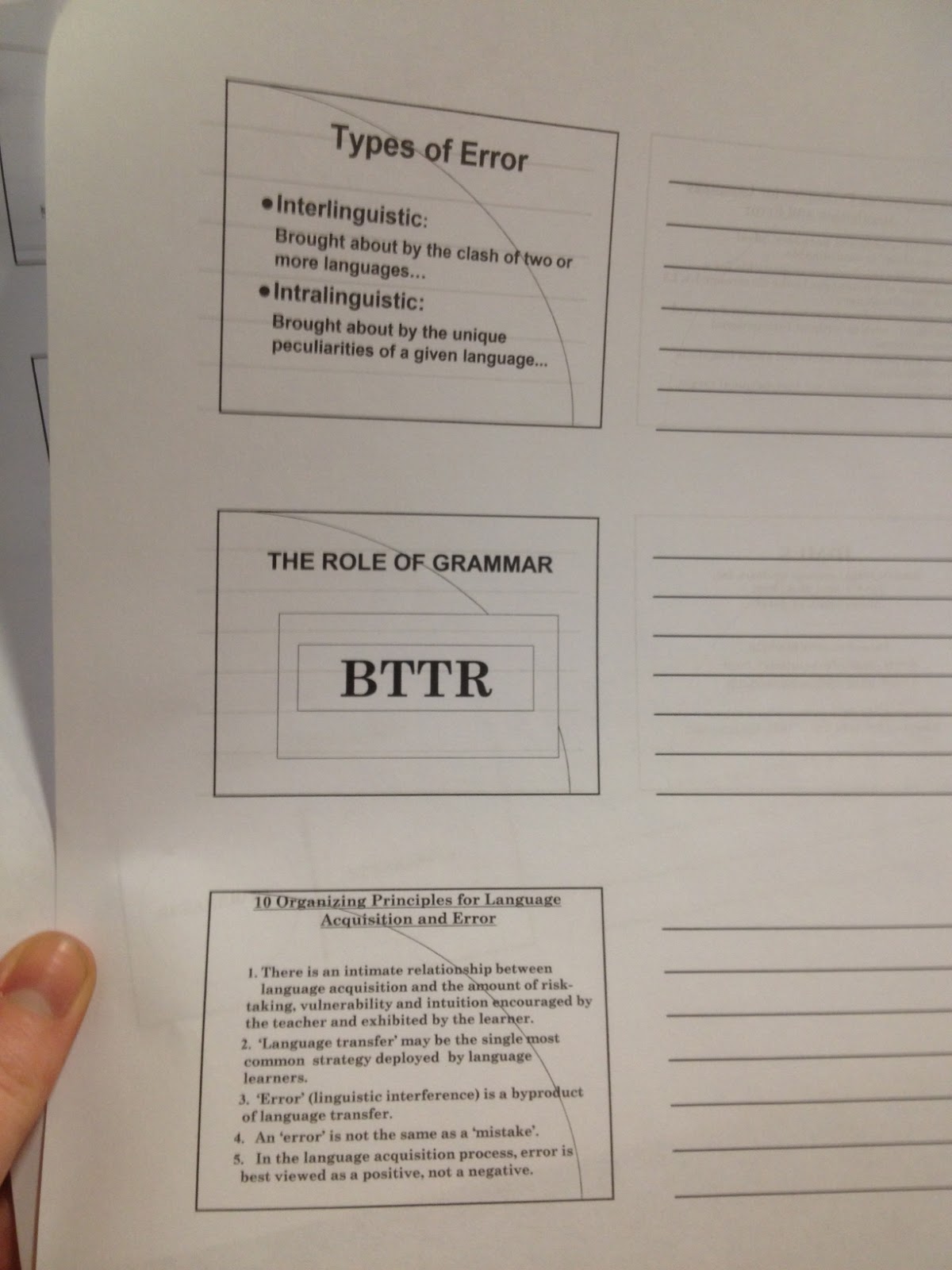
(all images below are the intellectual property of John De Mado and no copyright infringement is intended)

John De Mado spoke about the existence in language classes of not one, not two, but in fact three languages that any instructor a second or foreign language must deal with. The L1, the L2, and the student’s own interlanguage as he negotiated the movement from L1 to L2. 


He discouraged teachers from becoming editors of student interlanguage. Jokingly, he imitated the “gringo” accent of a typical American student learning Spanish (“tango” instead of “tengo” for example). While, as language teachers and language lovers, our natural tendency is to cringe or yell when we hear students say “grassy ass” instead of “gracias,” he begged us not to constantly edit our students. 


He asked us why we are afraid of letting students make errors. Overwhelmingly the answer given was fossilization. He shocked the audience of teachers by asserting that at the level that we teach there is no such thing. It was easy to hear the scoffs and see the rolling eyes. He repeated and insisted it was true! There was no evidence that our students were capable of fossilization because 1) they have such minimal language and 2) if they choose to pursue past level four or so, they won’t choose to fossilize. Choose to fossilize? Again, the audience scoffed but De Mado insisted that fossilization is a loss of facility and it is a choice to stop actively pursing and studying the language. It is a choice to discover and work toward correcting mistakes. 


Our students do not make mistakes, they make errors, he asserted. These are non-permanent. However, if we run students off they will never take ownership of the language and work to correct their errors. He asked how much we would spend to renovate an apartment that we didn’t own? Would we spend $10,000? $20,000? Of course not! It is not ours! So it is the same with language. As long as teachers are the editors and providers of language, it doesn’t belong to the student. They need put forth no effort to improve it. 


He suggested three strategies for facilitating language learning in a way that encourages students to own it. We need to create a safe space where risk-taking can happening. In the real world, students will need to take risks to use the language with native speakers. Second, we must leave room for intuition about language, as it would occur outside of the classroom. This means when a student pauses, we don’t give the answer, but give them time to work it out. Finally, we must let them be vulnerable. Help them understand that errors are a natural part of the process and that is how they learn.


He encouraged us to remove the word “mistake” from our professional vocabulary and always use the word “error” which basically carries the meaning of a learning opportunity. 
Another important strategy to make risk-taking, vulnerability, and intuition (RVI) successful in the classroom environment is to add it to the rubric and make it least worth as much as “accuracy” is. This way students take these behaviors seriously and you can encourage them to engage in the more readily because they are required. 


Returning to the metaphor of a language like a home, he asked what most people’s first homes look like. Most, he asserted, are “fixer uppers.” 


The role of grammar is to reduce error. It is largely non-communicative. It is identification, not communication. It doesn’t exist to create communication, it’s purpose is to avoid miscommunication. If students buy into the language in an upper level, then they can focus on grammar but at the beginning levels, the focus should be on communication with grammar serving only to support that communication. 
On a side note, if you ever get the chance to hear John De Mado speak, I highly recommend it. He is a high-energy and highly entertaining public speaker who really seems to know his stuff. Check out his website for some resources too. http://demado-seminars.com/

Teaching Foreign Languages in the Elementary School: A Service Learning Initiative


Teaching Foreign Languages in the Elementary School: A Service Learning Initiative: E. Nicole Meyer meyern@uwgb.edu

E. Nicole Meyer is a professor of French, Humanistic Studies, and Gender Studies at the University of Wisconsin-Green Bay. In addition to her many duties, she coordinates and administrates a service learning project for undergraduate French students to teach elementary students some French. 


There are two sides to Meyer’s initiative, the undergraduates and the elementary school. The service provided to the elementary school is one in which those children volunteer to spend their recess, and in the coming semester after-school time, learning French. For the undergraduates, this is experience is a 1 or 2 credit internship style course. 


In order to set up a program like this Meyer emphasized the need to develop good relationships with elementary or preschool administrators. They will be key in making the program a success. It will be necessary to have a time and location for the sessions. Advertising and communication with parents will also be important. Scheduling for both the children and the undergraduates can be a challenge. 


From the university perspective, Meyer recommends that the undergraduate students be at least fifth semester language learners in order to have the necessary language ability. Before they are sent out they are then required to study second language acquisition theory. The students are required to develop a teaching portfolio of resources and lesson plans to pull from, complete with journal reflections and reports of their experiences once they begin in the classroom. Throughout the experience, the participants meet frequently to share resources and ideas. 


Content of the sessions include a basic introduction to the language, cultural exploration, and songs. Some activity ideas Meyers shared included: coloring books (Dover Books); using students’ backpacks for vocabulary; musical chairs with vocabulary or questions on post-it notes on each chair (in order to sit, students must answer the question); plastic easter eggs full of slips of papers with questions or vocabulary; cubes with clear sleeves on all sides with cards (cubes are pairs-one with verbs, one with subjects, for example); fake school store; matching games; giant paper (from a newspaper office) to draw big pictures on; and a TL party or celebration. 


This program is highly customizable depending on what needed to be accomplished. Wherever there is a need, a program like this would be invaluable. Grants and research could be done to support these types of programs. Some ideas I have about similar programs are ELL programs for young students and their parents in communities where there aren’t many resources of this nature already; a technology-enhanced career search support class for displaced worker or computer-skills for people who are missing basic skills to even meet requirements for entry into other programs supported by instructional technology students or education students with special interest or skill in technology; a community cultural enrichment program in which international students share their experiences with children or interested community members who’ve never had the opportunity to travel. The list could go on. It is important to develop a strong sense of the goal of such a program and develop a list of potential resources and need as a first step. 

Thursday, February 23, 2012

Opportunity is what really matters

Am I an outlier? I don’t necessarily see myself as exceptional or super successful. However, I have been the recipient of an extraordinarily high number of exceptional opportunities. Neither my cultural or familial heritage, nor my heredity, can be easily seen in who I have become at my current age of 30. My parents are hardworking blue collars, though my mother is now going back to school at the age of 49 to pursue a career as a medical technician. My grandparents are honest and caring rural residents who would be most proud to be described as good Christians. I am not ashamed, nor do I in any way make light of who my family is. They are exactly who they want to be and I love them dearly. However, it was my opportunities, on top of the inspiration they provided me to always try to be a good person and treat others fairly, that allowed me to become who I am today.

My first big opportunity came in the form of my high school Spanish teacher. A tiny, lively woman named Mary Lee Mitchell. Señora Mitchell did two things that sent me down my path with a skip. She showed me a love for the Spanish language unlike any other and she recommended me for a federally funded college-prep program called Upward Bound.

Upward Bound opened my eyes to a wider world than most kids born in Patrick County, Virginia are ever privileged enough to see. I met students from all over southwestern Virginia and together we learned so much more than how to get into college. We learned how to be successful in more fundamental ways. We learned to network. We had the opportunity to visit places like New Orleans, Orlando, Cleveland, and Columbus, to name a few. We were exposed to cultural events and visited many different universities up and down the eastern United States. Mostly, we learned the important lesson that we were good enough.

College started a little rough. Maybe I was overconfident. It took me a little while to find my place. Another amazing opportunity opened up to me when I met my husband, Brian. Brian and I were both students at Surry Community College in Dobson, NC. I was trying to get my grades back up from my false start. He was finishing an associates’ degree. When I met him, Bri was already accepted and due to start college at Appalachian State University in Boone, NC that fall. Lucky for me, he wasn’t opposed to my tagging along.

At Appalachian I found my home in the department of foreign languages and literatures. I connected with and learned from amazing colleagues, friends, and faculty. The supportive environment of the department was exactly what I needed to finish my undergraduate degree. In fact, I loved it there so much, I stayed on to complete a Master’s degree as well.

It was at that point I began again to search for what my next step would be. I knew I loved teaching introductory-level Spanish classes and that I was most happy at the university-level. Unfortunately, I was also aware that with only an MA, I stood little chance of earning tenure or a paycheck I could afford to live on. I was very unsure of what I wanted to do next. I knew I wasn’t interested in any PhD program in Spanish that I had ever heard of. I had only a passing interest in literature and linguistics and I knew that would not be enough to sustain me through a rigerous PhD program and a dissertation.

Fortunately, I heard about a degree over in the Reich college of education called an EdS, or Educational Specialist degree. Specializing in higher education, I found many interesting topics like assessment and accreditation, diversity in the classroom, and developmental education. I so enjoyed my EdS program, I couldn’t believe how fast it flew by.

Meanwhile, I still hadn’t managed to figure out where I was going next. In the summer before the last year of my EdS, I happened to hear about a program related both to assessment and foreign language study and managed to get involved. I was the only university-level instructor in an initiative that was clearly aimed at K-12 teachers. However, when the keynote speaker at the introduction conference gave her speech I happened to noticed that I recognized her name. Dr. Ali Moeller was on my very long list of contacts for potential PhD programs.

After her captivating keynote on assessment, I got an opportunity to speak with Dr. Moeller. She asked where I worked and when I told her, she asked if I knew a colleague of hers there, Dr. Beverly Moser. When I told her I used to be Dr. Moser's graduate assistant, she asked if I was “the one who builds the websites.” Apparently, my previous mentor had at some point been bragging about me. I was taken aback and honored.

This connection led me to my current home in Lincoln, Nebraska where I am thoroughly enjoying pursing a PhD in teacher education with Dr. Moeller. I feel like I am exactly where I should be and I am very happy and honored to be here. However, I recognize that I am here because of a long string of lucky opportunites. I am lucky to have been a student of Señora Mitchell’s. I am lucky to have been a participant in the Upward Bound program. I am lucky to have met my husband and followed him to Appalachian State. I am lucky to have been an assistant of Dr. Moser’s. I am lucky to now be studying with Dr. Moeller.

I am successful, not because I am a genius of some sort nor because my family had money or connections. I am here because I recognized and took advantage of every opportunity that was afforded me. I work hard because I appreciate where I am and I want to continue to take advantage of every opportunity I can. Mostly, I want to recognize these opportunities because others’ deserve them and I want to give back in any way that I can.

Am I an Outlier? I don’t know, but I believe Malcolm Gladwell is 100% right. Talent is important. Hard work is very important. But opportunity is also especially important.

Wednesday, February 22, 2012

Change the way you understand memory, Read this book!

Joshua Foer trained for one year and became the U.S. memory champion. In this book, he details his year of training and some techniques of mnemonics, as well as why remembering things are important and how this idea fell out of favor in the educational system.

This may be the most interesting non-fiction I've ever read. Foer's descriptions of the characters he met along his journey, especially his coach, Ed Cooke, are so rich I feel like I know these fascinating individuals. Personally, I'm inspired. I don't think I'll ever become a card memorizer but I plan to investigate ways to use this in the classes I take and those I teach. It's a fantastic and relatively quick read and I highly recommend checking it out.


Check out Foer's own synopsis:

Saturday, February 11, 2012

MBLGTACC


Two workshops and one keynote down, I’m about halfway through my MBLGTACC 2012 experience and I am so glad I came. The atmosphere here at Iowa State, despite the bitter cold outside, is warm and happy. Last night’s keynote speaker, Rev. Jamie Washington, set the tone of awareness and change. His talk, “Living, Leading, and Leaving the World Better,” challenged us to “get intentional” about making connections and preparing for the next step. He asked us to get introspective about how we are living, how we are leading, and how we are leaving. He encouraged us to be inclusive, change agents, reminding us that we did not begin this movement and it will not end with us.

My 8am (!) workshop was called “Debunking Myths about BDSM” and was led by Tynan Fox (http://www.tynanfox.com/). I was really touched to learn more about this dimension of sexuality, which Fox often referred to simply as kink. He emphasized that this was just the way he had always been and there was no reason for BDSM and kink to have the stigma that it does. This is not solely, nor even necessarily, about the traditional definition of sex. He talked about many myths but left us with the one truth that he hopes will become myth: Kinksters are invisible. 

At 9:15am, I attended Justin Ford’s presentation on Unpacking Privilege. I can’t say enough about how impressed I am with Ford’s presentation style. His activities engaged the audience on a deeply personal level. Yes, we all have different privileges and different levels of privilege depending on the various identity lenses, but making that statement versus really feeling its intention and meaning is the difference between reading this and being there. Ford emphasized more inclusive language about privilege, “racial” instead of “white” and “gender” instead of “male,” and the responsibility of those with various privileges to take action against these advantages and work together toward the common goal of equalizing the field. He concluded with a challenge to make a pledge to (1) be aware of our privilege; and (2) take action to equalize those advantages. (see document posted below)

I can’t wait to experience more of this remarkable conference and I am already getting really excited about MBLGTACC 2013! 
--
The following document is the intellectual property of Justin Ford and is used here with his permission.
30 Day Privilege Pledge

Tuesday, August 30, 2011

Learning is questioning what I "know" to be "true"

Last week I sat in on my very first doctoral class. During that class I found myself in disagreement with the professor. Thinking back logically on this experience, I know that my professor is "smarter" than me. What I mean by that is that he has progressed further in his educational process than I have. All week I have had difficulty focus on the ideas presented in this class because I believed I had a fundamental disagreement on what education and learning mean.

Today a former colleague and trusted friend posted an article on Facebook. That article backed my professor's position on one issue with which I had found myself in disagreement. However, because of my trust in my colleague, I took the time to read the article and found myself changing my mind on the issue entirely and seeing my professor's point.

Now on one hand I make the observation that this is what doctoral work should do. It should make me question what I "know" to be "true" and provide me with a vehicle for navigating and advancing my progress on my own educational path.

On the other hand, it made me wonder, why does it seem that we are not encouraging students to do this at the undergraduate level? During my EdS program, I took an entire course on how to determine if what I was reading was "good." There were many characteristics that we developed in that course, the one that stands out in my mind is whether the source is a "classic" (as simply defined as possible, a well-accepted and oft-quoted source). Another was to look at who had published the work and if that person/organization had a reputation for carefully publishing well-researched information.

My brain meltdown occurred when I thought about the fact that students (myself included) are more likely to begin research online, where self-publication makes everyone's ideas available and that new information that hasn't yet been canonized is abundant.

So, how do we determine if information is "good" or "bad" and how do we facilitate our students' understanding and critical thinking skills in this area? This has led me to begin developing ideas around this issue.

As a part of one of my doctoral courses, we are developing an Instructional Design Model (based on research by Morrison, Ross, and Kemp (see this link for more information: http://www.quasar.ualberta.ca/edit573/modules/module4.htm).

I'm using this model to attempt to work through the idea of helping student become more critical consumers of information. Skills that I believe become more and more important during the age of Internet research.

I will post my model on this blog as I continue to develop it. I believe dialogue and the exchange of ideas is one of the most important processes of learning. That being said, my question is what do you think? What do you believe? What do you presume to be true?

But how do you know? Who says? Well who is that? Why does what they say matter? Would you interpret their data differently? Did they structure their study to really measure what it should? How do you know? Who says? Well who is that? … ad infinitum …

Tuesday, March 22, 2011

Is a break a vacation or an opportunity for more study?

A recent article in The Chronicle of Higher Education discussed Cornell University’s faculty senate’s creation of a policy to help reduce student stress by discouraging surprise homework assignments before an academic break. The policy is meant to encourage faculty members to describe in detail large assignments on syllabi at the beginning of the semester and not to assign previously unannounced large homework assignments a few days before academic breaks due only a few days after them. The policy is currently being revised to emphasize that what is being discouraged is only “surprise” assignments. The decision to work on assignments over break can then be left up to individual students.

I think the policy is a wise one. Some students will work better on assignments spread out over long periods of time. Others prefer to work uninterrupted through a break. Having the entirety of spring break to work on my comprehensive exams made the process a more productive and enjoyable one because I could plan to be in the library all day every day of break. Some of my colleagues preferred to take break as a time to relax and reflect and either completed the majority of their work before or after the week off.

Cornell is cited as being a leader among colleges trying to identify and support troubled students, especially after several students died in apparent suicides in a short period of time. This policy is meant to be a step in the right direction toward helping students deal with stress by measuring out their workload in a way that works best for them.

The policy is not meant to force faculty one way or another according to Dr. William E. Fry, dean of the university faculty at Cornell, but instead to promote best practices. He also emphasized that academic breaks existed to allow students to relax and recharge. If faculty plan out major assignments in advance, students can plan their work accordingly and prevent the stress of last minute assignments. This should be considered best practices because highly stressful study is rarely productive in products or learning experiences.

Mr. Bruce Levitt, author of the policy to discourage surprise homework over breaks, hopes the faculty will continue to “focus on ‘specific and targeted ways’ to reduce some of the stress” and that the real core of these issues will need to involve a conversation at the administrative level of the university.

Student leader, Vincent P. Andrews, commented in an editorial for the campus newspaper, that though this is a step in the right direction, more will need to be done to address the root of the problem of student stress levels. He worries that this policy may encourage faculty to cram additional work into the weeks before and after break instead and, in turn, to cause students more stress. One other option Mr. Andrews addresses is the possibility of faculty within colleges collaborating on dates for midterms and major assignments, as there is currently no school-wide date for midterms.

I think it is important for faculty to be cognizant of breaks when working on curricular planning. For example, I schedule my classes so that students have almost no work over midterm break. I also attempt to organize my schedule so that the last week of classes is spent on review with no new material to be learned as students are completing final projects. It’s also been my experience in the higher education program that faculty tend to plan well to give students ample time to complete assignments as they see fit. I'm curious how other educators handle the issue of scheduling academic work around school breaks.


Rae, T. (2011, March 2). Cornell Faculty Senate to Consider 'Strongly Discouraging' Surprise Homework Over Breaks. The Chronicle of Higher Education. Retrieved from http://0-chronicle.com.wncln.wncln.org/article/No-More-Breaks-Ruined-by/126562/


Saturday, March 19, 2011

Do We Have To Go To Class?

“Actually Going to Class, for a Specific Course? How 20th-Century.: New learning technologies prompt a rethinking of traditional course structure,” Jeffery R. Young, February 27, 2011.

This article explored the problems many faculty have of student attendance in a face-to-face classroom and how different types of technology are affecting this issue. The author cited that much research has shown learning outside of the traditional face-to-face classroom has the potential to be more deeply engaging for students. He also pointed out that traditional lecture and testing in classes often leads to quickly memorized, and soon forgotten, facts. Students are also cited as valuing learning outside the classroom. So Young asked “Why even have a traditional college course?”

Young touched on the controversial new book Academically Adrift: Limited Learning on College Campuses and the accusation that traditional college education asks little of students and produces small efforts from them. Throughout the article, research and examples promote the idea of linking skills learning in classes to efforts outside the classroom.

Much of my research and experience reinforces the idea that learning must become relevant to students in order to engage their interests. The article discusses an evolution in education that is being driven by student demand, a better understanding of how students learn, and a new generation of faculty members trying tech-infused teaching methods. I would also emphasize that simply using technology is not enough to engage students; these technologies must be used well.

The article cited one professor who uses an anonymous pop quiz, asking students questions like whether they discussed the homework with a classmate and how long they spent on the reading, to demonstrate that class discussion only works when students are prepared. This professor wants his students to see him as a guide, not a gate keeper of knowledge. This is what is essential, instructors simply reading a textbook that students are perfectly capable of reading on their own is not engaging learners. Students need to be co-creators of knowledge, not passive receivers of it. Some other ways this professor used to engage students to collaborate with one another included encouraging them to pass notes in class on Twitter and to create blogs to share their insights on the course material. He then created a “mother blog” to house and link to each student’s blog. This allowed the students to collaborate with one another and engaged them to such a degree that they wanted to continue to use these tools after the course ended.

Another school created 7-week immersion programs with no lecture component that brought students together to collaborate and create. The article expands on one undergraduate student’s efforts to create a social network for “unstudents” to connect to mentors and learn by modules at their own pace, completely self-directed. Online classes that essentially provide the same content that professors regurgitate in lectures are accessible to students seeking alternatives to traditional college settings.

So what is the point of going to class when instructors are forced to use attendance policies and pop quizzes to keep students in their seats? Will the traditional college environment cease to exist? Young argues that colleges will always serve to bring smart, motivated students together in a single community. However, as one professor from Virginia Tech warned, if instructors do not expect much from students, they won’t complain. As educators, we must be facilitators of learning seeking to engage students, not just founts of knowledge now easily accessible online.


Young, J. R. (2011, February 27). Actually Going to Class, for a Specific Course? How 20th-Century.: New learning technologies prompt a rethinking of traditional course structure. The Chronicle of Higher Education. Retrieved from http://0-chronicle.com.wncln.wncln.org/article/Actually-Going-to-Class-How/126519/

Tuesday, February 8, 2011

Studying Developmental Education in Higher Education

Effective Practices for Developmental Education

The following points are considered the most effective practices in Developmental Education from the text referenced below. In a subsequent post, I will discuss three of these practices in more detail.

Organizational and Administrative Practices:

1.1 Developmental education is a clearly stated institutional priority.

1.2 A clearly articulated mission based on a shared, overarching philosophy drives the developmental education program. Clearly specified goals and objectives are established for developmental courses and programs.

1.3 The developmental education program is centralized or is highly coordinated.

1.4 A comprehensive system of support services exists and is characterized by a high degree of integration among academic and student support services.

1.5 Institutional policies facilitate student completion of necessary developmental coursework as early as possible in the educational sequence.

1.6 Faculty who are both knowledgeable and enthusiastic about developmental education are recruited and hired to teach in the program.

1.7 Institutions manage faculty and student expectations regarding developmental education.

Program Components:

2.1 Orientation, assessment, and placement are mandatory for all new students.

2.2 Counseling support provided is substantial, accessible, and integrated with academic courses and programs.

2.3 Financial aid is disseminated to support developmental students. Mechanisms exist to ensure that developmental students are aware of such opportunities, and are provided with assistance to apply for and acquire financial aid.

2.4 Regular program evaluations are conducted, results are disseminated widely, and data are used to improve practice.


References:
Boroch, D.; Hope, L., Smith, B., Gabriner, R., Mery,P., Johnstone, R., & Asera, R. (2010). Student success in community colleges: A practical guide to developmental education. San Francisco, CA: Jossey-Bass.


Thursday, October 21, 2010

The Social Classroom-An Interview with the guys over at The Tightwad Tech

Mark and Shawn over at The Tightwad Tech interviewed me for the podcast on using Social networking tools in the classroom. Check it out here: http://bit.ly/PodcastOnFacebook

I'd love to hear your thoughts! Leave a comment below. :) Thanks!

Monday, October 18, 2010

The (Mis/Over)Use of Technology in my Classroom

The number one most important thing you need to know about the way I view teaching is that I value student feedback. Students know what they need and want and that must be considered when lesson planning. Recently, I asked students to complete an anonymous survey to give me some feedback on how my classes are going this semester. I got the following wonderful comment from one of my students:

"The only thing I'm not sure how I feel about is how technological the class is. It's nice to be more modern but when your computer decides to not work for a night you're screwed. And it's difficult to remember to turn something in online that you already turned in in class. Which reminds me I need to go do that..."

At first when a teacher hears this kind of comment, I think our natural reaction is to think that the student is just being lazy or disorganized but when I start really thinking about this statement, I know I've been hearing it since the beginning of the semester. As you might imagine, if you know me at all, this is a complaint I get every semester and I have a tendency to let it in one ear and out the other because I do believe that incorporating technology is important and even though I teach Spanish, I also teach life skills to some extent.

However, I'm also a student and I've been using a lot of technology for presentations and work. My colleagues are always very impressed but it really makes me reflect on how much tech is involved in my classes. Just because I find using a website or blog instead of a PowerPoint easier, doesn't mean that it is true for everyone. This student comment really has me reflecting on the fact that I have two, quite large, major assignments this semester that are portfolio-style projects and they are both online besides the online workbook and other random online exercises. It occurs to me now, and it probably should have occurred to me earlier, this is too much!

To take a step back, I'm going to offer my students the option of completing one of the two projects on paper, if they consider it a simpler option. I'm also going to create a grade sheet to outline everything they have due so they can check each off as complete. (Thanks to Dr. Bonham for the inspiration on that one!) I hope that will help resolve my students' issues and help them focus on the subject matter and less on the technology.

The important lesson here is that is vital to listen to our students, take criticism well, and be prepared to modify lesson plans when it makes good sense to do so.